Contents
The ask
What we did
Assignment 2, Writing Online Content, is about transforming content into engaging self-study digital lessons. I opted to build a custom solution leveraging a piece of educational content I had the opportunity to create in recent years.
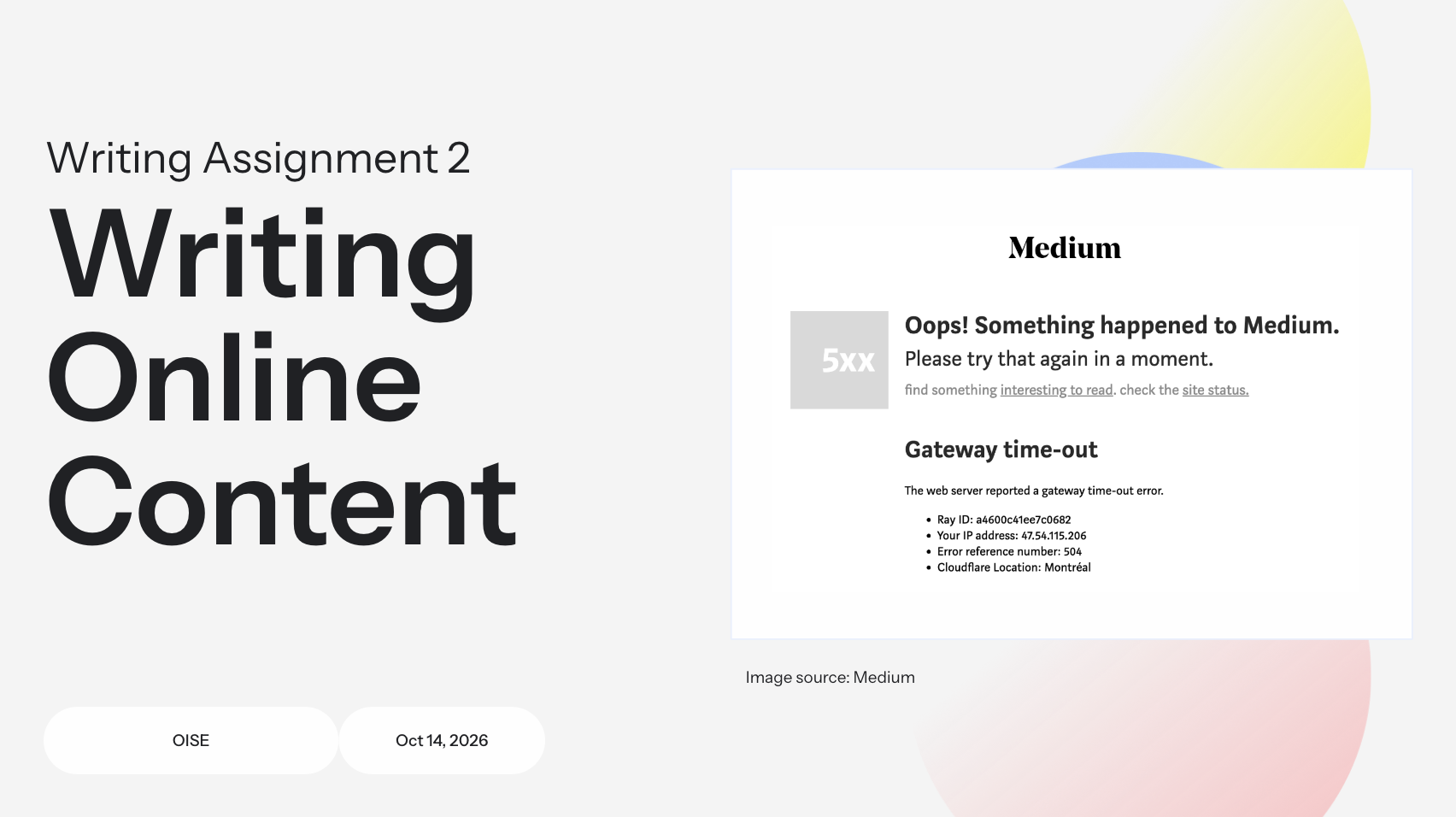
Above: Writing Assignment 2 - Writing Online Content title page with an example of a 504 Gateway time-out error from Medium.com.
Project at a glance:
Approach: Video, presentation, and exercise templates
Project title: Designing Error State Interfaces
Audience: Product Designers
Problem statement: Design a better way for designers and engineers to collaborate on error states so that they are well designed for end users in time for engineering hand off.
Goal: Confidently plan for, collaborate on, and design solutions for thoughtful error state experiences that help users easily identify, diagnose and recover from expected and non-standard error states in user interfaces.
What's in it for learners:
- Improving error state experiences for end users
- Avoiding engineering timeline delays
- Anticipating engineering needs related to error state designs
- Centralizing error states for unified experiences
The learnings
How I'm growing
How my thinking is evolving:
- Anchoring this work in a relatable persona helped me get to the core goal for my learner.
- Learner Goal Example: Design error states before engineering begins implementing the designs so that designers are not pulled back into a project while the engineering team is working on a late night pull request.
-
Building a learning experience introduction or overview helped me think long and hard about communicating the benefits of the learning experience.
-
Example: Design error states before engineering begins implementing the designs so that designers are not pulled back into a project while the engineering team is working on a late night pull request.
-
What to expect:
- Improve error state experiences for users
- Anticipate engineering needs to avoid delayed engineering timelines
- Build for unified experiences
-
What to expect:
-
Example: Design error states before engineering begins implementing the designs so that designers are not pulled back into a project while the engineering team is working on a late night pull request.
- Chunking the content helped me consider where my solution needed to be trimmed down, reformatted, and reapproached.
- Presenting insightful and captivating statistics at the beginning of the lesson helped me think more about evoking emotions early from the learner.
- I need to get creative when creating learning experiences. Content needs to come in many shapes so that it keeps the learner engaged and helps them flex their new skills.
- I'm pleased to see how writing lean and considering the delivery format of my content is improving my writing skills.
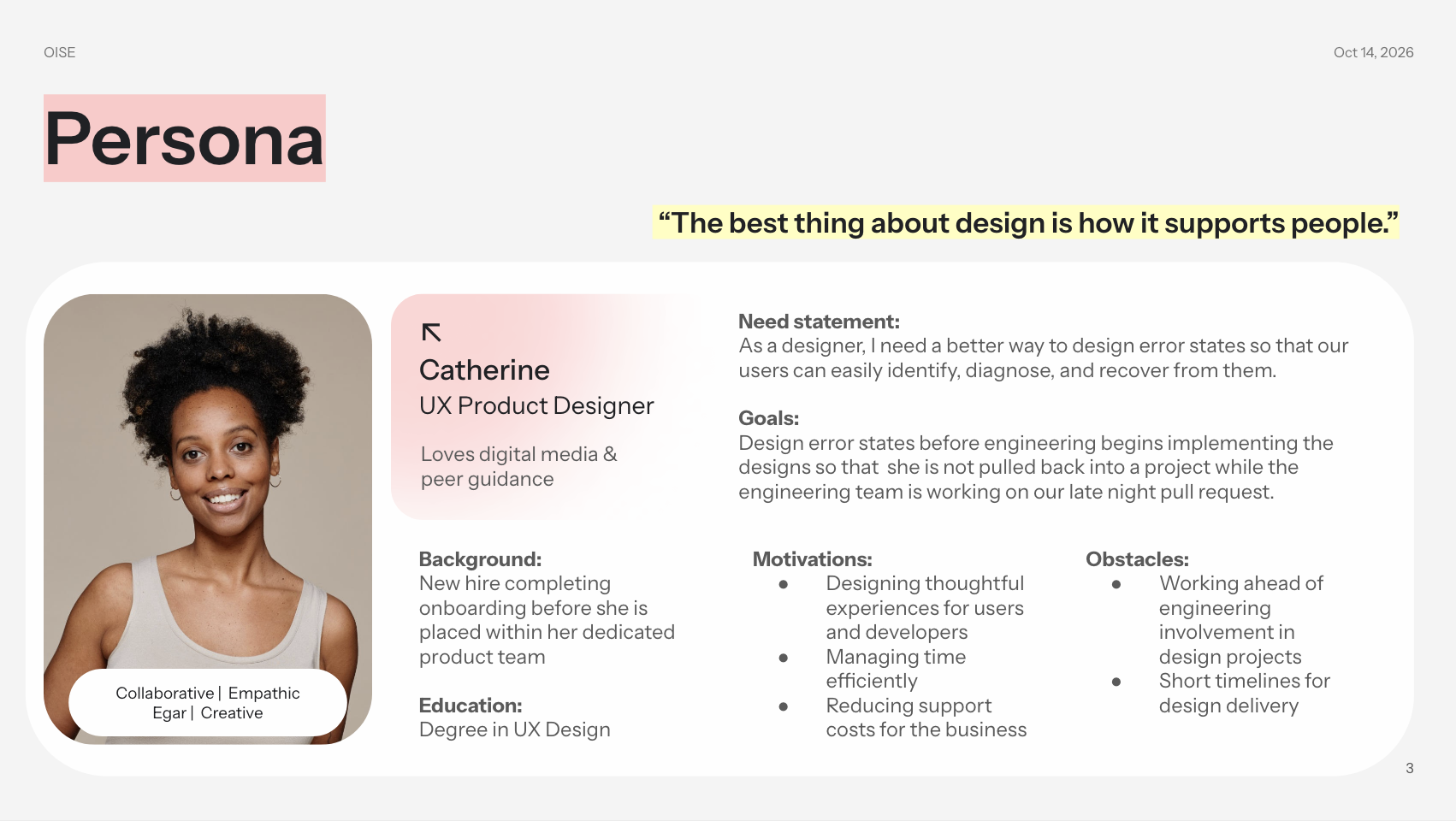
Above: Excerpt from the Writing Assignment 2 - Writing Online Content showing a UX Product Designer Persona that also includes a quote, “The best thing about design is how it supports people.”
Surprises that came up:
I had forgotten how dense this subject matter is and realize that I have an even bigger challenge ahead in future iterations because I want to make it more accessible to folks who may have some experience with standard error states but are unfamiliar with non-standard or unexpected error states
How I am being challenged:
- Writing good content for learning experiences is the core challenge for me because I have partnered with amazing editorial people in my career and they have set a high bar for the level of writing talent I'd like to achieve.
- I keep having moments of reflection and growth where I ask myself:
- “What are the benefits of this approach for our learners?”
- “What's in it for my audience?”
- “How can I make this more engaging by mixing it up?”
- “How can I attach this to an existing piece of knowledge for the learner?”
-
Some of the major improvements made in this version of the learning experience included:
- adding supporting metrics to evoke emotion early
- infusing activities along the way to support the learner in their collaboration peers
- I'd like to see myself better apply scaffolding by attaching new concepts to existing knowledge because this subject is pretty dense for those who are unfamiliar with the concept of http responses even though http responses are the foundation of hyper text transfer protocol (aka the internet.) Many people do not know how the internet works even though they design for it.
A story from my practice:
I began designing learning material for other designers on error states more than 5 years ago. It is a greatly misunderstood area of design and it is also under served. This course has challenged me to put metrics behind the learning content to help others see the value in why error states should matter to them instead of being an afterthought. It's clear that bad error states are costly and designers can take the time to learn how to better collaborate on them so that they come to the table prepared with solutions that work for engineering. Asking me to think about the learning content through this lens has made this content more impactful and my hope is to continue improving it. The timeline for this project was short and so I felt I had to skip a few of the steps I would normally have taken to build out the supporting content in a better way. Thank you for challenging us this week because it set us up for success. I can feel myself growing new writing skills.
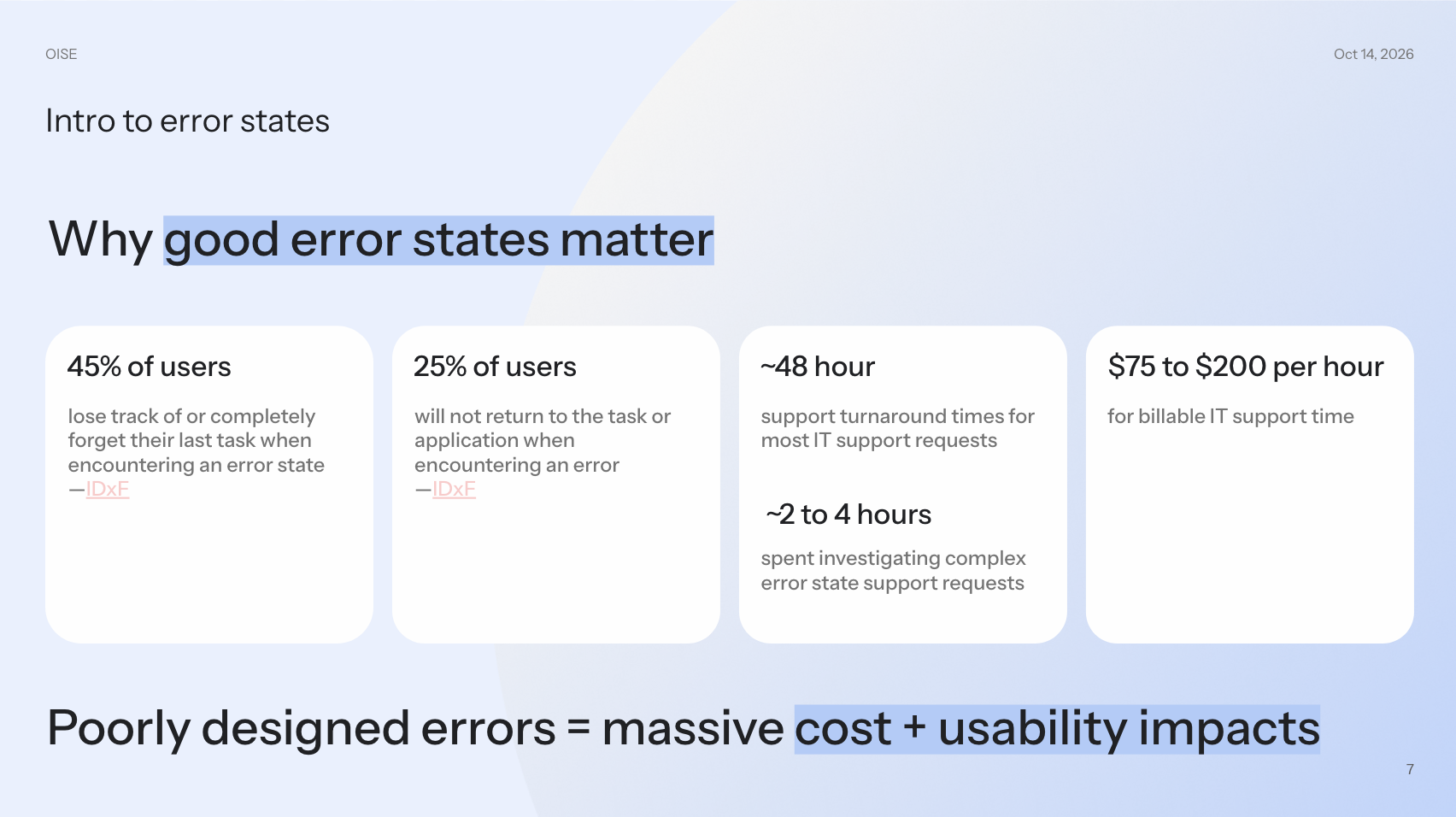
Above: An excerpt from the Writing Assignment 2 - Writing Online Content that shows metrics on why good error states matter, reinforcing the message, “Poorly designed error [states] equal massive cost and usability impacts.”
Enjoyable moments of delight
A lot of the work I do in my career is completed under non-disclosure agreements which prevent me from sharing some of my best work with others. I found it extremely enjoyable working through this as a class exercise because it is giving me the opportunity to improve a piece of work I wasn't able to take with me in previous roles. Having the ability to share this work with others is the best part of this assignment.
Next steps
What's next?
Things I can do in future
- I'd like to build more activities into my learning presentations and record supporting video tutorials. I believe that this will help me engage the viewer and solidify their knowledge as they play safely using their new skills.
- Designers are being recruited from various disciplines that don't include traditional design education or backgrounds. Knowing this helps us meet our learners' expectations in creative ways so that we can bring them along with us as the design space evolves to be more inclusive of individuals without formal design education.
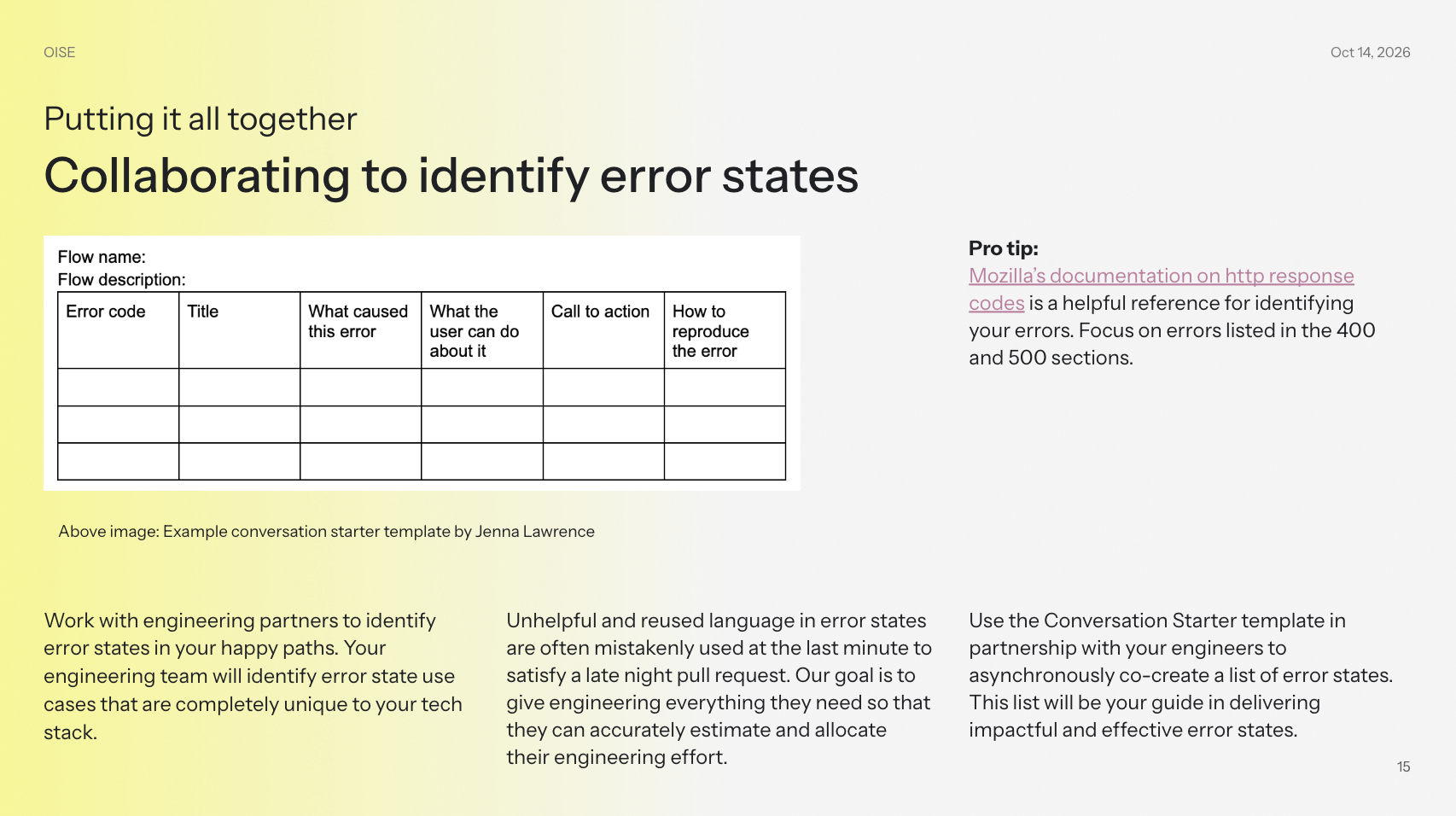
Above: Excerpt from Writing Assignment 2 - Writing Online Content where learners can use a job aide template to collaborate with their engineering partners to identify error states.
Burning questions:
Some of the open questions I still have include:
- How can companies make APIs accessible to designers so that they can self-discover error states when engineers have not yet onboarded to the project? I have yet to get the solution on this because engineering needs to be involved to build solutions integrated with APIs for us to begin discovering possible error states.
-
How can we get engineers more involved in building better error states in partnership with design? I ask this because on teams where I have been empowered to collaborate with engineering on error states we have found some really unusual examples and built exciting solutions to solve for them. On other teams where engineering is less engaged, I have witnessed them cutting corners on error states and even refusing to collaborate on error state enhancements.
- Solutions: Good design requires good partnerships and advocacy from leadership. Anything we can do to incentivise learning and collaboration is going to help employees build better solutions.
Conclusion:
Error states are something we should all care about because there are costly financial impacts to our business when error states are difficult to recognize, understand and recover from. As I rethink my approach to these deep learning moments, I am growing to better accommodate learners by keeping the content digestible and diversifying its presentation to keep learners engaged.
What is your understanding of http responses and have you partnered with engineers to better serve error states for your audience?
Connect with me to open discussions on how we can better serve error states.